
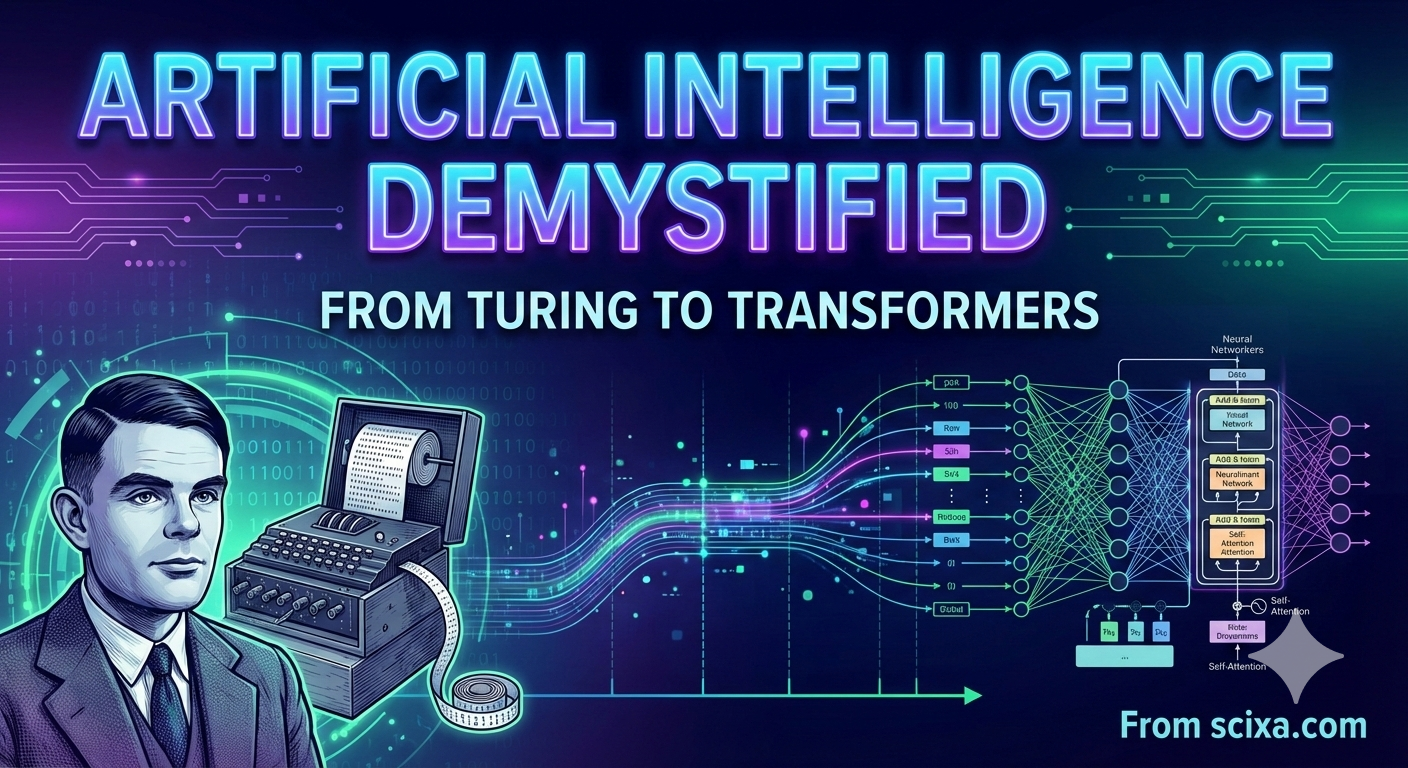
🤖 Artificial Intelligence Demystified: From Turing to Transformers
📋 Table of Contents
📚 Introduction: The AI Revolution
Welcome to the Most Important Technology of Our Time
Imagine waking up in the year 2026. Your alarm didn't just ring—it analyzed your sleep patterns, checked your calendar, and gently woke you during light sleep. Your coffee maker started brewing because it learned your morning routine. On your way to work, your car navigated through traffic using real-time predictions. Your email client drafted responses, your phone filtered spam calls, and your music service created the perfect playlist for your mood.
None of this is science fiction. It's all powered by Artificial Intelligence. But here's the fascinating part: the AI that makes all this possible has a rich history dating back to the 1950s, with intellectual roots going even further back.
By the end of this comprehensive lesson, you will be able to:
- 🎯 Trace the evolution of AI from philosophical concepts to modern deep learning
- 🎯 Explain the Turing Test and its modern implications
- 🎯 Compare and contrast symbolic AI, machine learning, and deep learning
- 🎯 Understand the transformer architecture that powers ChatGPT, Gemini, and Claude
- 🎯 Apply AI concepts through interactive exercises and real-world examples
- 🎯 Analyze ethical implications and future directions of AI
Figure 1: Key milestones in AI development (1950-2024)
Why Should You Care About AI?
Here's a thought-provoking question for you: Will AI replace your job, or will you work alongside AI? According to a 2024 McKinsey report, by 2026, 50% of current work activities could be automated. But here's the good news: the same report suggests that AI will create 97 million new jobs. The key isn't to compete with AI—it's to understand it.
Think of AI as the printing press of the 21st century. Just as the printing press didn't make writers obsolete (it made books accessible to everyone), AI won't make humans obsolete—it will augment our capabilities. But to harness this power, you need to understand its foundations.
🎓 Learning Path Recommendation
Based on your interaction patterns, we recommend starting with the historical foundations. If you're already familiar with basic concepts, you can skip to the Transformers section using the table of contents above.
🧪 Alan Turing & The Imitation Game
The Man Who Asked: "Can Machines Think?"
In 1950, the journal Mind published a paper that would change the world forever. Its author, Alan Turing, a brilliant mathematician who had just helped win World War II by cracking the German Enigma code, posed a seemingly simple question: "Can machines think?"
But Turing was too clever to ask such a vague question. Instead, he proposed a concrete test—one that would become known as the Turing Test (or the "Imitation Game").
The Imitation Game Explained
Imagine you're in a room with two computer terminals. One is connected to a human, the other to a machine. You can ask any questions you want through the terminals, and after a period of conversation, you have to decide which is which. If you can't reliably tell the difference—if the machine can imitate human responses well enough to fool you—then the machine has passed the test.
Figure 2: The Turing Test setup - judge interacts with both terminals
Why the Turing Test Was Revolutionary
At the time, most philosophers believed that thinking required a soul or consciousness—something machines could never possess. Turing sidestepped this philosophical debate entirely. He said, in effect: "Who cares about the philosophical definition of thinking? If a machine can convince you it's human, then for all practical purposes, it's thinking."
This pragmatic approach was characteristic of Turing. He wasn't interested in abstract debates about consciousness—he wanted to know what machines could actually do.
The Legacy of the Turing Test
For decades, the Turing Test was the holy grail of AI research. In 2014, a chatbot called "Eugene Goostman" supposedly passed the Turing Test by convincing 33% of judges it was human. However, critics pointed out that the chatbot used tricks—claiming to be a 13-year-old Ukrainian boy whose first language wasn't English—to explain away its mistakes.
Modern AI systems like GPT-4 can carry on conversations that are virtually indistinguishable from humans in short exchanges. But does that mean they're "thinking"? Not necessarily. This brings us to an important distinction:
| Aspect | Human Thinking | AI "Thinking" |
|---|---|---|
| Consciousness | Subjective experience, self-awareness | No subjective experience |
| Learning | Understands concepts deeply | Recognizes patterns in data |
| Creativity | Consciously creative | Recombines existing patterns |
| Understanding | Genuine comprehension | Statistical prediction |
💡 Think About This
When you talk to ChatGPT, are you talking to something that understands you, or are you watching a very sophisticated parrot that's really good at predicting what words should come next? This isn't just a philosophical question—it has practical implications for how we use and trust AI systems.
Beyond the Turing Test: Modern Alternatives
Today, researchers have proposed alternatives to the Turing Test that might better capture machine intelligence:
- The Winograd Schema Challenge: Tests common-sense reasoning through pronoun resolution
- The Lovelace Test: Tests creativity—can AI create something genuinely novel?
- The Employment Test: Can AI perform economically valuable work as well as a human?
📜 Symbolic AI & The Expert Systems Era
When AI Was All About Rules and Logic
In the 1950s and 60s, AI researchers took a straightforward approach to intelligence: if humans think by manipulating symbols (words, concepts, rules), then machines could do the same. This approach became known as Symbolic AI or "Good Old-Fashioned AI" (GOFAI).
The idea was elegant: represent knowledge as facts and rules, then use logic to derive new conclusions. For example:
Facts:
→ Socrates is a man.
→ All men are mortal.
Rule:
→ IF X is a man THEN X is mortal.
Conclusion:
→ Socrates is mortal.
The Rise of Expert Systems
By the 1980s, symbolic AI had evolved into practical expert systems—programs that captured the knowledge of human experts in specific domains. The most famous example was MYCIN, developed at Stanford University to diagnose bacterial infections and recommend antibiotics.
MYCIN had around 600 rules. A typical rule looked like this:
IF (1) the site of the culture is blood, and
(2) the gram stain of the organism is gram-negative, and
(3) the morphology of the organism is rod, and
(4) the patient is a compromised host
THEN there is suggestive evidence (0.7) that Pseudomonas aeruginosa is a likely pathogen.
MYCIN was remarkably accurate—in tests, it outperformed most junior doctors and matched the performance of senior specialists. Yet it was never used in clinical practice. Why? Because doctors didn't want to be second-guessed by a machine, and the legal liability was unclear.
Figure 3: Architecture of an Expert System
The Strengths of Symbolic AI
- Explainability: You could ask "Why did you recommend this antibiotic?" and MYCIN would show you the chain of rules it used.
- Precision: In well-defined domains, rule-based systems can be extremely accurate.
- No training data needed: You just need experts to articulate their knowledge.
The Limitations That Led to AI Winter
- Brittleness: If you gave MYCIN a case that didn't exactly match its rules, it couldn't "guess" or generalize.
- Knowledge acquisition bottleneck: Extracting knowledge from experts was time-consuming and expensive.
- Common sense: Symbolic systems had no common sense. They couldn't understand that "the cup is on the table" means you can pick it up.
- Scale: As the number of rules grew, they began to conflict with each other in unpredictable ways.
By the late 1980s, these limitations, combined with funding cuts, led to the first "AI Winter"—a period of reduced interest and investment in AI research. But the field would soon be reborn with a completely different approach.
📊 The Machine Learning Revolution
Teaching Machines to Learn from Data
Imagine trying to write a program that recognizes handwritten digits. With symbolic AI, you'd have to write explicit rules: "If the image has a loop at the top and a vertical line, it's probably a 9." But handwriting varies so much that such rules would quickly become impossibly complex.
Machine learning takes a radically different approach. Instead of giving the computer rules, you give it examples and let it figure out the rules itself.
Figure 4: Traditional programming vs. Machine learning approach
The Three Pillars of Machine Learning
Machine learning isn't one technique—it's a family of approaches, each suited to different types of problems.
🎯 Supervised Learning
Like a student learning with an answer key. You provide labeled examples (e.g., emails labeled "spam" or "not spam"), and the algorithm learns to predict labels for new examples.
Real-world use: Spam filters, image classification, medical diagnosis
🔍 Unsupervised Learning
Like an explorer discovering patterns without a map. You provide unlabeled data, and the algorithm finds hidden structures or groupings.
Real-world use: Customer segmentation, anomaly detection, recommendation systems
🏆 Reinforcement Learning
Like training a dog with treats. An agent learns by interacting with an environment, receiving rewards for good actions and penalties for bad ones.
Real-world use: Game-playing AI (AlphaGo), robotics, autonomous vehicles
A Concrete Example: Spam Filter
Let's see how machine learning solves the spam problem:
- Collect data: Gather 10,000 emails, half spam, half legitimate.
- Extract features: Convert each email into numbers—word frequencies, presence of certain phrases, sender information, etc.
- Train: Feed the features and labels into a learning algorithm (e.g., Naive Bayes, logistic regression).
- The algorithm finds patterns: It might learn that emails containing "Nigerian prince" are almost always spam, while emails from your mother never are.
- Predict: When a new email arrives, the algorithm calculates the probability it's spam based on the patterns it learned.
The beauty of this approach is that the algorithm adapts to new spam tactics. When spammers start using new phrases, your spam filter can be retrained on new examples—no manual rule-writing required.
| Algorithm | Best For | How It Works | Example |
|---|---|---|---|
| Linear Regression | Predicting numbers | Finds best-fit line through data | House price prediction |
| Logistic Regression | Binary classification | Predicts probability of belonging to a class | Spam/not spam |
| Decision Trees | Interpretable decisions | Series of if-then questions | Loan approval |
| Random Forests | High accuracy | Combines many decision trees | Credit scoring |
| Support Vector Machines | Complex boundaries | Finds optimal separating hyperplane | Image classification |
| K-Means | Clustering | Groups similar points together | Customer segmentation |
🧠 Key Insight: The No Free Lunch Theorem
Here's something surprising: there's no single best machine learning algorithm. As the "No Free Lunch" theorem states, any algorithm that performs exceptionally well on one type of problem will perform poorly on others. That's why data scientists maintain a toolkit of algorithms and experiment to see what works best for their specific problem.
The Data Diet: Why More Data Beats Better Algorithms
A famous 2009 paper by Google researchers showed something counterintuitive: for many problems, adding more training data improves performance more than improving the algorithm. This insight has driven the modern AI industry's hunger for data.
Think of it this way: if you want to teach a child to recognize cats, showing them 100 cats is better than giving them a sophisticated theory of "catness." The same principle applies to machine learning—though with the caveat that the data must be high-quality and representative.
🧠 Deep Learning & Neural Networks
Learning from the Brain (Sort Of)
In 2012, a neural network called AlexNet crushed the competition in the ImageNet challenge, an annual competition to recognize objects in photos. Its error rate was nearly half that of the second-best entry. This moment marked the beginning of the deep learning revolution.
But what are neural networks, and why did they suddenly become so powerful?
Figure 5: A simple neural network with two hidden layers
The Neuron: Nature's Inspiration
A biological neuron receives signals through dendrites, processes them in the cell body, and if the combined signal exceeds a threshold, fires an electrical impulse down its axon to other neurons. Artificial neurons work similarly:
- Receive inputs: Numbers from other neurons or the data
- Weight them: Each input is multiplied by a weight (importance factor)
- Sum them: Add up all the weighted inputs plus a bias term
- Activate: Apply an activation function to decide whether to "fire"
Mathematically: output = activation(∑(weight_i × input_i) + bias)
Why "Deep"?
A "shallow" neural network might have just one hidden layer. A deep neural network has many layers—sometimes hundreds. Each layer learns to detect patterns at different levels of abstraction:
- First layers: Detect simple features like edges, corners, or colors
- Middle layers: Combine simple features into shapes (eyes, wheels, windows)
- Deep layers: Recognize complex objects (faces, cars, buildings)
This hierarchical learning is what makes deep networks so powerful. They automatically discover the right features for the task, rather than relying on humans to design them.
The Magic of Backpropagation
How do neural networks learn? Through an algorithm called backpropagation (backward propagation of errors). Here's the intuition:
- The network makes a prediction (say, "this is a cat")
- It compares its prediction to the correct answer ("actually, it's a dog")
- It calculates how much each neuron contributed to the error
- It adjusts the weights to reduce the error next time
- Repeat millions of times
It's like tuning a very complex instrument by listening to the sound and adjusting each string slightly until it's perfect.
🚀 The Deep Learning Breakthrough: Why Now?
Neural networks were invented in the 1950s. So why did they only take off in 2012? Three factors aligned:
- Big Data: The internet provided millions of labeled images, videos, and texts
- GPU computing: Graphics cards designed for video games turned out to be perfect for neural network math
- Better techniques: New activation functions (ReLU), regularization (Dropout), and initialization methods made deep networks trainable
Real-World Applications
- Computer Vision: Facial recognition, medical imaging, autonomous vehicles
- Speech Recognition: Siri, Alexa, Google Assistant
- Natural Language Processing: Translation, sentiment analysis, chatbots
- Game Playing: AlphaGo, AlphaZero, Dota 2 bots
- Drug Discovery: Predicting protein structures, designing new molecules
But deep learning had one more revolution in store—one that would transform how machines understand language.
⚡ Transformers & The Attention Mechanism
The Paper That Changed Everything
In 2017, a Google team published a paper with a deceptively simple title: "Attention Is All You Need." Little did the world know that this paper would spark a revolution in AI, leading directly to ChatGPT, GPT-4, Gemini, Claude, and every other modern large language model.
Before transformers, most language models used recurrent neural networks (RNNs) that processed text one word at a time, maintaining a hidden state that captured the context so far. This was slow and struggled with long-range dependencies—by the time you reached the end of a long sentence, the network had forgotten the beginning.
Figure 6: Attention weights show how much each word focuses on others
What is Attention?
Imagine you're reading a long sentence: "The animal that the farmer saw in the field yesterday and that had been causing trouble for weeks finally escaped." When you get to "escaped," your brain naturally pays attention to "animal" because you need to know what escaped. You don't give equal weight to every word—you focus on the important ones.
That's exactly what the attention mechanism does. For each word in a sentence, it calculates how much attention to pay to every other word. This creates a rich, context-aware representation where each word's meaning is influenced by all the words around it.
Self-Attention: The Key Innovation
Transformers use self-attention, meaning each word attends to all other words in the same sentence. For the sentence "The bank of the river was beautiful," the word "bank" would attend strongly to "river" to understand that it's a river bank, not a financial bank.
Mathematically, attention works like this:
Attention(Q,K,V) = softmax(QK^T/√d)V
Where:
- Q (Query): What am I looking for?
- K (Key): What information do I have?
- V (Value): Once I find relevant keys, what information should I pass along?
- √d: A scaling factor to prevent extreme values
Multi-Head Attention: Seeing from Multiple Perspectives
Transformers don't just use one attention mechanism—they use multiple attention heads in parallel. Each head can learn different types of relationships:
- Head 1: Syntactic relationships (subject-verb agreement)
- Head 2: Semantic relationships (synonyms, antonyms)
- Head 3: Coreference (pronouns referring to nouns)
- Head 4: Positional relationships (nearby words)
This multi-headed approach gives transformers their remarkable ability to understand language nuance.
Positional Encoding: Keeping Track of Order
Unlike RNNs, which process words sequentially, transformers process all words in parallel. This is great for speed, but it means they lose information about word order. To fix this, transformers add positional encodings—vectors that represent each word's position in the sentence.
These encodings use sine and cosine functions of different frequencies, creating a unique pattern for each position. This allows the model to understand that "dog bites man" is different from "man bites dog."
| Feature | RNNs/LSTMs | Transformers |
|---|---|---|
| Processing | Sequential (one word at a time) | Parallel (all words at once) |
| Long-range dependencies | Difficult (vanishing gradients) | Easy (direct connections) |
| Training time | Days to weeks | Hours to days |
| Context window | Limited (~200 words) | Large (up to 1M tokens in GPT-4) |
| Parallelization | Poor | Excellent |
From Transformers to ChatGPT: The Scaling Story
The transformer architecture scales beautifully. OpenAI discovered that if you make the model bigger (more layers, more attention heads) and train it on more data, performance keeps improving. This led to the scaling laws—empirical findings that model performance follows a predictable power law as you increase compute, data, and parameters.
GPT-3 had 175 billion parameters. GPT-4 is estimated to have over 1 trillion parameters. These massive models, trained on most of the public internet, develop capabilities their creators never explicitly programmed—like translation, coding, and reasoning.
🌟 The Magic of Emergent Abilities
As models cross certain size thresholds, they suddenly gain new capabilities. For example:
- Small models: Basic language modeling
- Medium models: Translation, summarization
- Large models: Chain-of-thought reasoning, few-shot learning
- Very large models: Code generation, mathematical reasoning, theory of mind
These abilities weren't designed—they emerged from scale.
The Transformer Family Tree
Since 2017, transformers have diversified into two main branches:
- Encoder-only (BERT family): Understand text. Great for classification, question answering, sentiment analysis.
- Decoder-only (GPT family): Generate text. Great for chatbots, story writing, code generation.
- Encoder-decoder (T5, BART): Translate between sequences. Great for translation, summarization.
⚖️ AI Ethics & The Road Ahead
With Great Power Comes Great Responsibility
As AI systems become more powerful, ethical considerations move from academic philosophy to urgent practical concern. Here are the key ethical challenges facing AI in 2026:
1. Bias and Fairness
AI systems learn from human data—and human data contains human biases. When Amazon built an AI recruiting tool, it learned to penalize resumes containing the word "women's" (as in "women's chess club captain"). When COMPAS, a tool used in US courts, predicted recidivism, it was biased against Black defendants.
The challenge: How do we build AI that is fair when the data reflects historical and societal biases?
2. Privacy
Large language models are trained on vast amounts of internet data, including personal information. Researchers have shown they can be prompted to emit training data, potentially exposing private emails, phone numbers, or confidential documents.
The challenge: How do we train powerful models while protecting individual privacy?
3. Transparency and Explainability
When a neural network with billions of parameters makes a decision, even its creators often can't explain why. This "black box" problem is critical in high-stakes domains like medicine, finance, and criminal justice.
The challenge: How do we build AI systems that can explain their reasoning?
4. Misinformation and Deepfakes
AI can now generate convincing fake images, videos, and text. This has already been used to create non-consensual deepfakes, spread political misinformation, and impersonate real people.
The challenge: How do we maintain trust in information when AI can fabricate anything?
5. Economic Disruption
As AI automates more tasks, jobs will disappear—and new ones will be created. The transition may not be smooth, and the benefits of AI may be concentrated among those who own the technology.
The challenge: How do we ensure the benefits of AI are broadly shared?
6. Existential Risk
A minority of researchers worry about a more fundamental risk: what if we build AI systems that are more intelligent than humans and have goals misaligned with ours? This "alignment problem" is the subject of intense debate.
The challenge: How do we ensure superintelligent AI remains under human control?
🔮 The Future: What's Next?
- Multimodal AI: Models that understand text, images, video, audio, and more—combined
- Agentic AI: Systems that can take actions, not just generate text
- Smaller, more efficient models: Running powerful AI on your phone, not just in the cloud
- AI in science: Accelerating drug discovery, materials science, and climate solutions
- Regulation: Governments worldwide are developing AI regulations—the landscape will look very different in 2027
✍️ Interactive Exercises & Self-Assessment
Test Your Understanding
🎯 Exercise 1: Match the AI Era to Its Key Feature
Drag each term to its correct description:
📇 Exercise 2: Key Concepts Flashcards
Click each card to reveal the definition:
❓ Exercise 3: Knowledge Check Quiz
1. What was the key limitation of symbolic AI?
2. What made deep learning take off in 2012?
3. What does the attention mechanism do?
💭 Exercise 4: Reflection Question
Based on what you've learned, how do you think AI will change your field of work or study in the next 5 years? Write a brief paragraph.
🧠 Concept Mind Map
📅 AI Timeline: Key Moments
Turing Test Proposed
Alan Turing publishes "Computing Machinery and Intelligence"
Dartmouth Workshop
Term "Artificial Intelligence" coined; birth of AI as a field
Expert Systems Boom
MYCIN, XCON bring AI to real-world applications
AlexNet Wins ImageNet
Deep learning revolution begins
Transformers Introduced
"Attention Is All You Need" published
ChatGPT Launches
AI goes mainstream with 100M users in 2 months
Today
AI integrated into every aspect of technology
📖 Interactive Glossary
Hover over any term to see its definition:
❓ Frequently Asked Questions
Will AI take my job?
AI will likely change jobs rather than eliminate them entirely. According to the World Economic Forum, while 85 million jobs may be displaced by 2025, 97 million new roles may emerge that are better adapted to the new division of labor between humans and AI. The key is to focus on skills that complement AI—creativity, emotional intelligence, complex problem-solving.
Is ChatGPT actually intelligent?
This depends on your definition of intelligence. ChatGPT can certainly perform tasks that would require intelligence if done by humans—writing essays, coding, reasoning. However, it lacks consciousness, understanding, and genuine creativity. It's better thought of as a "reasoning engine" that has learned patterns from text, rather than a conscious mind.
How do I start learning AI?
Start with the fundamentals: learn Python, understand basic statistics, and take online courses (Andrew Ng's Machine Learning course is a classic). Then specialize based on your interests—computer vision, NLP, robotics. Most importantly, practice by building projects. This lesson is a great first step!
What's the difference between AI, ML, and deep learning?
AI is the broad field of making machines intelligent. Machine learning is a subset of AI where systems learn from data. Deep learning is a subset of ML using neural networks with many layers. Think of it as Russian dolls: deep learning ⊂ machine learning ⊂ AI.
Can AI become conscious?
This is one of the most debated questions in AI. Some researchers believe consciousness could emerge in sufficiently complex systems. Others argue that current AI architectures fundamentally cannot be conscious because they lack embodiment, continuous experience, or the right kind of feedback loops. As of 2026, no AI system is considered conscious by mainstream science.
🔗 Connecting All Concepts
We've traveled from Alan Turing's philosophical questions to the transformers powering today's AI. Let's see how everything connects:
1950s-80s
Symbolic AI asked: can we program intelligence with rules?
1990s-2000s
Machine learning asked: can systems learn from data instead?
2010s
Deep learning showed: more data + bigger networks = better performance
2020s
Transformers proved: attention and scale unlock emergent abilities
The thread running through all of it? The human desire to understand and replicate intelligence—and in doing so, better understand ourselves.
📚 Additional Resources
📖 Books
- "Artificial Intelligence: A Modern Approach" (Russell & Norvig)
- "Life 3.0" (Max Tegmark)
- "The Alignment Problem" (Brian Christian)
🎓 Online Courses
- Andrew Ng's Machine Learning (Coursera)
- Fast.ai Practical Deep Learning
- CS231n: Computer Vision (Stanford)
📄 Key Papers
- "Attention Is All You Need" (Vaswani et al., 2017)
- "ImageNet Classification with Deep Convolutional Neural Networks" (Krizhevsky et al., 2012)
- "Computing Machinery and Intelligence" (Turing, 1950)