
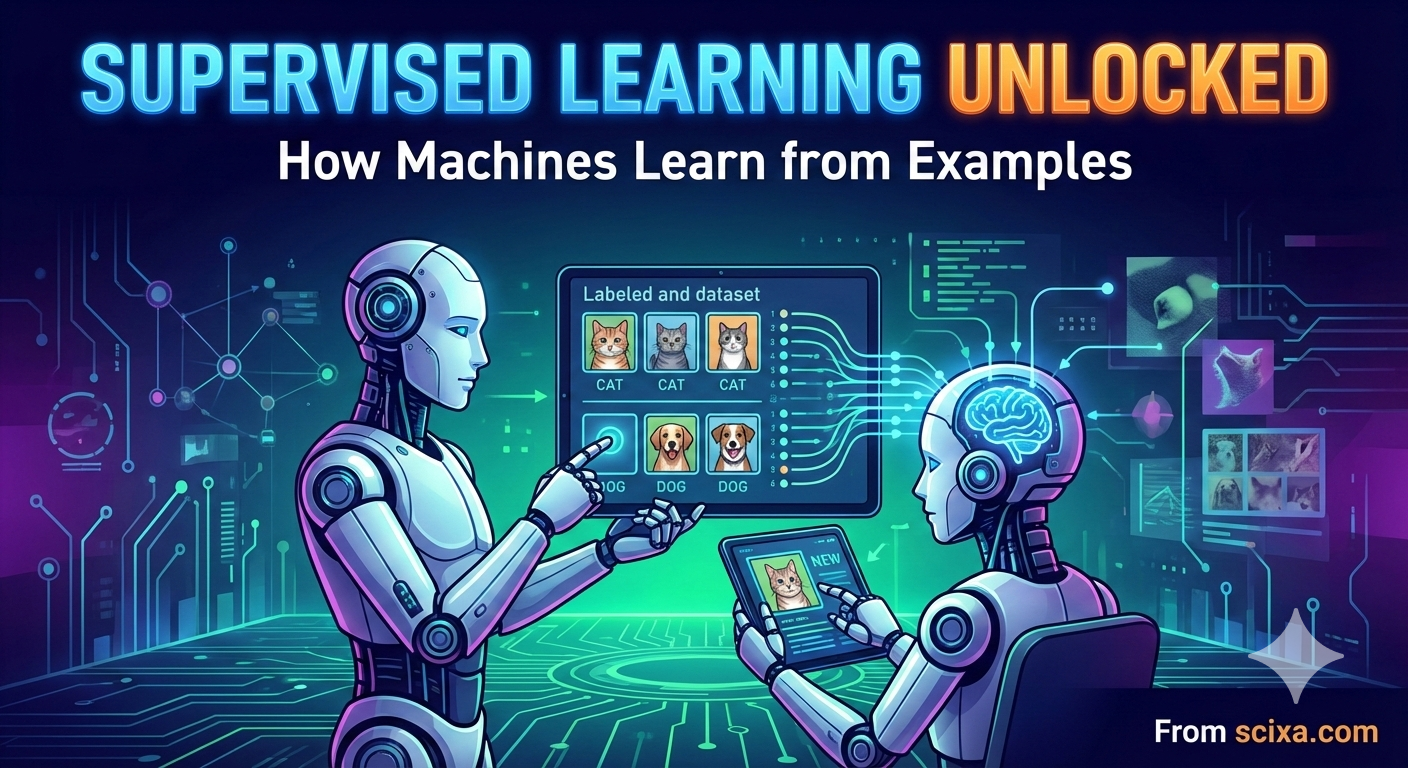
📘 Supervised Learning Unlocked:
How Machines Learn from Examples
Your journey from zero to hero — with interactive experiments, real-world stories, and adaptive intelligence.
🎯 Learning objectives & prerequisites
- Understand the core idea of supervised learning (you'll teach a computer like a child).
- Differentiate regression vs classification with real-life analogies.
- Build intuition about overfitting, training/testing, and evaluation.
- Implement a mental model of how algorithms learn from labeled data.
📚 Prereqs: basic programming curiosity, no heavy math needed — we use stories.
✨ beginner: analogies first, skip math details.
🧠 1. What does “learning from examples” mean?
Imagine you show a toddler 10 photos of "dogs" and 10 photos of "cats". Soon she can point to a new picture and say "dog!". That's supervised learning: you supervise by giving correct answers (labels) until the machine finds the pattern. Every day we use it: spam filters, face recognition, movie recommendations.
✨ Blue circles = cats, orange squares = dogs. Machine finds the boundary.
🔑 2. Core ingredients: features, labels, model
Features are the clues (like weight, fur length). Label is the answer (cat/dog). Model is the brain that learns the mapping.
📖 Analogy: features are the questions on a job application, label is “hire or not”.
| Term | Job hiring example |
|---|---|
| Features | years experience, education, interview score |
| Label | hire (1) / no hire (0) |
| Training | show past decisions |
| Model | decision rule |
📈 3. Regression vs Classification – the fork
Classification predicts a category (spam vs not spam). Regression predicts a number (house price). Think: are you picking a team or guessing a score?
🧪 Example: predicting temperature tomorrow (regression) vs sunny/rainy (classification).
⚙️ 4. Training and testing: don't cheat on the exam
You split data: training set (like textbook exercises) and test set (final exam). The model never sees test answers during training. Otherwise it 'memorizes' but fails on new questions — that's overfitting.
🧪 5. Overfitting analogy: the cookie thief
A child learns that cookies are in the kitchen. But if you only show him the exact cookie jar, he'll think cookies only exist in that jar. That's overfitting — too specific. Better: show cookies in different places (generalize).
🖱️ 6. Activity: drag the algorithm to the task (classification / regression)
Drop each into correct zone:
🔬 7. Supervised vs Unsupervised (comparison)
| type | labels? | example |
|---|---|---|
| supervised | yes | email spam filter |
| unsupervised | no | customer segments |
| reinforcement | rewards | game playing |
🧩 8. Concept mind map: supervised learning universe
click nodes to highlight (conceptual).
📘 9. Real‑world story: diagnosing diabetes
In 2024, a clinic used supervised learning on patient records (age, BMI, glucose) to predict diabetes onset with 85% accuracy. The model learned from 10,000 historical cases. It now alerts doctors early. This is a binary classification example (diabetes yes/no). Features: non‑invasive measurements. This saved countless lives. That's the power of learning from examples. Another example: autonomous cars identify pedestrians (classification) and estimate distance (regression).
📘 10. Under the hood: linear regression simple explanation
Linear regression finds a line: y = wx + b. w = weight (how much feature matters). b = bias. During training, the model adjusts w and b to reduce error (difference between predicted and actual). It's like guessing a friend's score based on hours studied: you find the best trend line. The computer does this with a method called gradient descent — it's like walking downhill in the dark to find the lowest point (minimum error).
📘 11. Decision trees – if this then that
Ever played "20 questions"? Decision trees ask a series of yes/no questions: is age > 30? is salary > 50k? Each split leads to a prediction. Easy to understand but can overgrow (overfit). Pruning cuts back the tree for better generalization. 2025 research combines trees with neural nets.
📘 12. Metrics matter: accuracy, precision, recall
You built a model that predicts if an email is spam with 99% accuracy. But if only 1% are spam, a model that says 'not spam' always gets 99% — useless! That's why we use precision (of those marked spam, how many are really spam) and recall (of all spam, how many caught). For example, cancer detection needs high recall (catch all cancers) even if some false alarms.
📘 13. Training/validation/test split best practices
Typical split: 70% train, 15% validation (tune parameters), 15% test (final score). In 2026, cross‑validation is standard for small datasets. Always keep test set hidden until the end. Data leakage is when test info sneaks into training (like using future data to predict past) – big no.
📘 14. Bias‑variance tradeoff – Goldilocks zone
High bias: model too simple (underfits). High variance: too sensitive (overfits). You want the sweet spot. Analogy: archer whose arrows are consistently off (bias) vs arrows all over the place (variance). Ensemble methods like random forest reduce variance.
📘 15. Feature engineering – raw data to insight
Raw data rarely fits. You transform: date to day of week, text to word counts, categories to one‑hot vectors. Good features make simple models great. For house pricing, feature "distance to city center" is more useful than just latitude. Automated feature engineering tools (e.g., FeatureTools) are rising in 2025.
📘 16. Ethics and fairness in supervised learning
If you train a hiring model on biased past decisions (e.g., men hired more), it learns to discriminate. In 2024, regulations require fairness audits. Techniques like reweighting or demographic parity help. Always ask: does my data reflect reality or prejudice?
📘 17. Interactive self‑assessment: quick quiz
Q1: Spam detection is A) regression B) classification?
answer: classification.
Q2: What's the term for memorizing training data? overfitting.
Q3: true/false: you should test on data used for training. false.
📊 your learning analytics & recommendations
You explored 0 sections. Keep going!
💡 recommendation: open more cards to strengthen basics.
📌 final summary – the big picture
Supervised learning = teaching by labeled examples. You now understand features, labels, regression/classification, overfitting, and evaluation. Every time you tag a photo or get a recommendation, supervised learning is at work. Practice with small datasets, and remember: the machine learns patterns, but you guide the learning with data and ethics. Congratulations — you've unlocked the core!